
HDB Renovation Ideas: 3-Room, 4-Room, and 5-Room HDB

Purchasing a HDB unit is a significant financial investment for Singaporeans. However, a standard unit handovers often feature highly predictable, uniform layouts that lack personal character and spatial efficiency. Homeowners frequently require the renovation services of a professional renovation contractor in Singapore or an interior design expert to optimize these residential spaces.
Modern HDB housing layouts require strategic space planning. Current interior design trends reject cold and sterile environments. Instead, homeowners prioritize smart storage, seamless transitions, and durable materials suited for tropical climates in Singapore.
This guide analyzes efficient interior design strategies, renovation ideas and standard HDB layouts for 3-room HDB, 4-room HDB, and 5-room HDB across Singapore. These concepts balance aesthetic appeal with daily utility.
[Table of Contents]

3-Room HDB Renovation Ideas: Spatial Optimization
A standard 3-room HDB encompasses a compact 60 to 70 square meters of floor space. This compact footprint requires precise spatial planning. Young couples, single owners, and downsizers frequently purchase these units. The primary design objective is the removal of visual clutter to maximize light and perceived space.
The Design Strategy: Open-Concept Layouts
Interior designers expand small areas by removing non-structural partition walls. Merging the compact kitchen with the living and dining areas creates a single communal zone. This structural change maximizes the flow of natural light from the main windows. Homeowners can use clear glass sliding doors with black aluminum frames or low half-walls if they require physical boundaries.
Storage solutions must utilize vertical wall space. Homeowners should request full-height and handleless built-in cabinets from their renovation contractor. These sleek fixtures sit flush against the wall to maintain clean architectural lines. This approach prevents freestanding furniture from crowding the limited floor area.
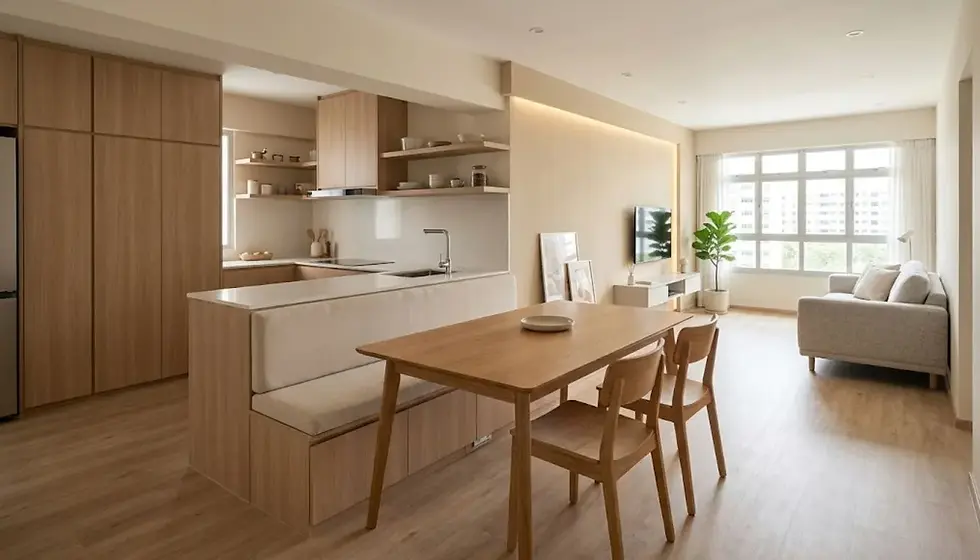
Singapore Case Study: Kempas Road (3-Room BTO)
BTO layouts at Kempas Road illustrate this spatial challenge perfectly. Traditional handovers feature a restrictive and enclosed kitchen that chokes the adjacent living area.
Hacking the kitchen walls transforms the room into an open culinary zone with a streamlined and L-shaped quartz counter. The color palette relies on warm neutrals like sand, beige, and light oak woodgrain laminates. These tones feel far more inviting than stark and hospital-white surfaces. Interior designers can also build a custom settee bench with internal lift-up storage directly under the dining table to save valuable floor space.
4-Room HDB Renovation Ideas: Flexibility and Balance
The 4-room HDB is the most common housing type for Singaporean families. These units offer a more comfortable 90 to 105 square meters of space. The standard layout includes three bedrooms, a living hall, a kitchen, and two bathrooms. Interior designers must focus on long-term adaptability for growing families.
The Design Strategy: Flexible Zoning and Japandi Aesthetics
The 4-room HDB layout offers excellent structural flexibility. Many homeowners modify the third bedroom rather than using it as a traditional sleeping area. Workers can replace concrete entry walls with floor-to-ceiling glass panels. This modification creates a bright, semi-private home office, a kids' playroom, or an attached walk-in wardrobe.
The Japandi style is highly effective for this flat size. This aesthetic mixes simple Japanese minimalism with useful Scandinavian functionality. The design utilizes organic textures like unbleached linen and rattan, hidden warm LED cove lighting, and earthy accent colors like sage green or clay terracotta. These elements add visual depth without creating a messy environment.

Singapore Case Study: Yung Loh Road (4-Room Resale)
Older resale HDB units at Yung Loh Road benefit greatly from layout reconfigurations. These spacious older units respond well to structural updates.
For example, a renovation contractor can alter the non-structural wall between the living room and the adjacent bedroom. The interior designer can introduce a curved archway or a half-glass partition to create a flexible home office nook. In the kitchen, a rounded breakfast counter connects the cooking space to the dining area. High-grade, moisture-resistant marine plywood prevents cabinet warping from heavy cooking steam, while handleless doors keep the appearance neat.
5-Room HDB Renovation Ideas: Cohesive Luxury
A 5-room HDB provides a generous canvas of 110 to 130 square meters. The footprint includes a large living hall, three bedrooms, and a designated study corner or extended dining area. The main design challenge is unifying the large layout so the rooms do not feel empty, cavernous, or cold.
The Design Strategy: Wet-Dry Kitchens and Detailed Accents
The large size of a 5-room HDB easily allows for a dual-kitchen system. The dry kitchen features a premium sintered stone island counter for hosting guests. Meanwhile, a clear glass sliding door isolates heavy cooking grease and smoke inside the wet kitchen area.
Luxury design relies on subtle architectural details rather than over-the-top decoration. Interior designers use slim fluted carpentry paneling, curved feature walls to soften sharp structural corners, and layered ambient lighting systems. Homeowners should avoid heavy false ceilings because they reduce room height. Recessed magnetic track lights and slim wall sconces provide a much better sense of volumetric depth.
Tip from Renovation Professionals:
Homeowners should install a single flooring material across the living room, dining hall, and dry kitchen. Large-format 80x80cm porcelain tiles or continuous luxury vinyl planks eliminate visual breaks and expand the space.

Singapore Case Study: Yishun Street 44 (5-Room HDB)
Modern layouts at Yishun Street 44 feature exceptionally long living rooms. Homeowners often struggle to arrange furniture in these elongated spaces without creating vast dead zones.
An asymmetrical media wall can divide the long hall into two distinct zones. One section forms a cozy family TV lounge lined with dark walnut wood panels. The opposing section becomes an open display gallery with floating glass shelves for collectibles and travel memorabilia. Additionally, the master bedroom can absorb the adjacent study area to create an expanded master suite with a private walk-in wardrobe enclave.
Summary of Key Design Elements Across Flat Types
The table below summarizes the core differences across HDB property types:
Flat Type | Average Size Range | Ideal Design Direction | Top Carpentry Solution |
3-Room HDB | 60 – 70 sqm | Warm Minimalism / Open Concept | Full-height handleless cabinets and built-in storage benches |
4-Room HDB | 90 – 105 sqm | Japandi / Flexible Multi-use | Glass-partitioned flex rooms and rounded breakfast counters |
5-Room HDB | 110 – 130 sqm | Refined Modern Luxury | Wet and dry split kitchens with central stone islands |
Every home layout is different, but a good renovation is always about a few simple things. You need to know how you move through your home. You must pick materials that last through daily use and wet weather. You also need to work with a professional renovation contractor who know the strict housing rules in Singapore. A good plan can change normal public housing into a personal, comfortable home. This plan can include breaking down old walls or building custom closets.

You May Also Like:


Comments