
How to Transform or Renovate Your HDB Service Yard into a Functional Utility Zone Without Major Hacking

If you’re looking to maximize every square meter of your home in Singapore, the service yard in your Housing & Development Board (HDB) flat often presents an under‑utilized opportunity. With clever planning, smart storage and design finesse, your service yard can evolve into a fully functional utility zone and you don’t necessarily need major structural hacking to do it. This article walks you through how to convert your HDB service yard into a multi‑purpose utility space, covering storage optimization, laundry & cleaning workflows, aesthetic upgrades, and compliance with local renovation rules.

Why bother renovating the service yard?
The service yard is often overlooked especially for young families, couples, resale owners alike may focus on kitchen, living or bedrooms, but the service yard remains a “back‑area” for washing machines, drying racks or storage. Yet in many HDB flats, the service yard can serve multiple functions when given a design overhaul:
It can become your laundry zone, with washing machine, dryer, fold‑space and hanging rods.
It can act as a utility hub or cleaning corner: mop and bucket, sink for rinsing, tool storage.
It can double as a mini‑garden nook, a drying area or even a pet‑friendly corner.
Being adjacent to the kitchen in many layouts, it can integrate with the kitchen flow for better utility.
According to design guides in Singapore, upgrading your service yard means you’re not only improving everyday living convenience but also enhancing the resale appeal of your flat.
Step 1: Respect the boundaries—no major hacking needed
If you want to keep costs lower and avoid the complexity of structural changes, here are some important renovation guidelines for HDB flats:
Before any hacking or wall removal, check whether the wall is load‑bearing or non‐load‑bearing. Many service yard walls are structural in HDB flats, so major wall removal is often not allowed.
Even if you’re only making minor modifications (carpentry, cabinetry, new fixtures), you still must comply with HDB’s renovation rules: working hours, noisy‑works restrictions, permit submission if required.
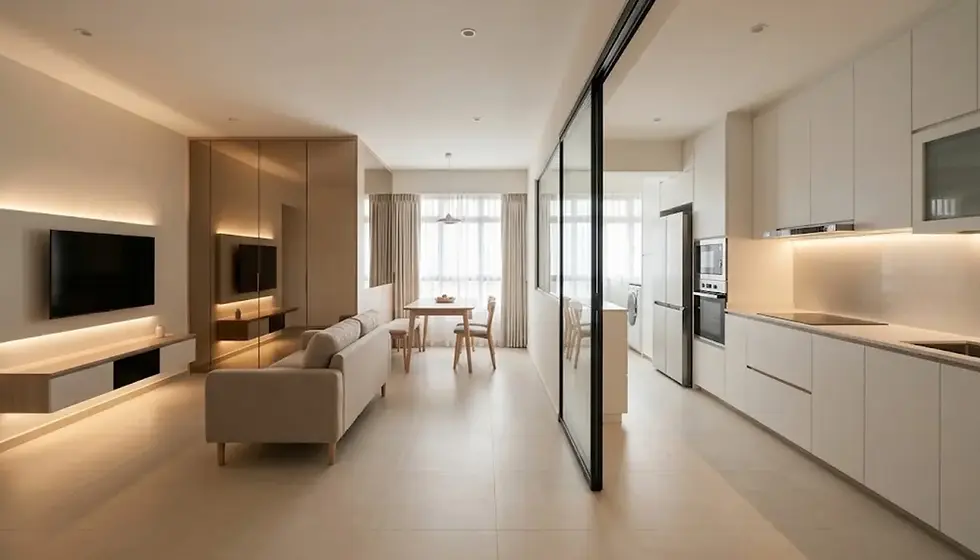
A full hack is not always necessary to gain utility: you can optically integrate the service yard with the kitchen via floor color, cabinetry alignment, sliding partitions or glass panels, without removing the wall entirely.
Step 2: Plan the layout—define zones within the space
Even modest service yards benefit from good layout strategy. Here are key zones to plan for:
Laundry zone
Position washing machine and dryer (stacked if possible) to maximize floor space.
Above the machine, build a counter for folding clothes or a shelf for laundry supplies (detergents, fabric softeners).
Wall‑mounted rods or ceiling pulleys for hanging clothes to dry especially useful in Singapore’s humid climate.
Utility/cleaning zone
Include a sink or drain area for hand‑washing, bucket rinse, mop cleaning.
Allocate vertical storage for brooms, mops, buckets, vacuum; use pegboards or hooks.
Consider concealed cabinetry to tuck away bulky tools and keep the space visually tidy.
Multi‑purpose or lifestyle zone
If layout permits, part of the service yard can double as a green wall, herb garden, or even pet‑wash area.
Use sliding glass partitions or clear panels to visually connect with the kitchen which helps with breeze and light.
Step 3: Smart storage solutions & vertical space saving
Space is often limited in HDB service yards, so making every inch count is vital. Here are concrete storage strategies:
Floor‑to‑ceiling cabinets: These use the full height of the wall and maximize storage volume with minimal footprint.
Stacked washer‑dryer: Instead of placing side by side, stacking opens up more floor room.
Over‑the‑machine counters: A countertop above your appliances becomes a prep/fold surface rather than wasted space.
Hidden compartments & sliding doors: Use sliding doors or pocket doors to conceal the laundry/utility zone when not in use which is helpful for maintaining aesthetics in open‑plan living.
Hooks, pegboards and racks: For brooms, mops, buckets that can be vertical hanging keeps them off the floor.
Step 4: Materials, lighting & finishing touches
Design and materials matter: you want your utility zone to be functional but also visually appealing and in line with Singapore living.
Durable flooring & wall finishes: Use non‑slip tiles, waterproof or moisture‑resistant finishes, especially since service yards often handle wet and drying activities.
Lighting: Bright, energy‑efficient LED lighting helps; consider under‑cabinet strip lights or overhead lighting so that tasks (folding, cleaning) can be done without strain.
Ventilation: Good airflow matters. If your service yard window or exhaust is under‑sized, you may consider upgrading it (with approval if needed).
Aesthetic continuity: To give the impression of a unified space, carry over tile or wall colour from the kitchen into the service yard or add glass partitioning.
Green touches: Vertical gardens, potted plants, herb walls help soften the utility feel and make the space more pleasant.
Step 5: Workflow & functionality—make it practical
Making the space look good is one thing; making it functional is another. Think about how you’ll use it daily:
Laundry logistics: Washing machine → drying rail/rod → folding counter → storage. Keep the path clear.
Cleaning routine: Designate space for mop bucket, cleaning supplies; include a wall‑mount for mops so nothing gets left on the floor.
Storage classification: Keep seasonal items or seldom‑used tools up high; day‑to‑day items at reachable height.
Hide the clutter: Use cabinetry or sliding panels to hide laundry machines or drying racks when you want a cleaner look.
Multi‑use activities: If part of your service yard is used for a herb garden or pet‑wash station, make sure the design considers drainage, cleaning access, and water proofing.
Step 6: Budgeting & cost considerations for Singapore homeowners
Even without major hacking, you’ll still want to set a realistic budget for your service yard transformation:
Simple upgrades like new cabinetry, lighting, and storage can cost less than a full renovation.
If you choose to remove a wall or add structural work (which you may avoid), the cost and permit requirements increase significantly.
Materials matter: Durable, moisture‑resistant finishes may cost more upfront but save on maintenance in Singapore’s humid, wet climate.
Work with a registered HDB renovation contractor; choose materials and labor carefully.
Remember timing and working‑hours restrictions which delays may increase cost or inconvenience neighbors.
Step 7: Compliance & contractor selection (Important for HDB owners)
Since you’re dealing with an HDB flat, it’s essential to follow regulations and choose the right contractor:
You’ll need to ensure your contractor is HDB‑registered.
Submit any required applications or permits if your works involve hacking or structural change.
Make sure the contractor is clear on working hours (weekdays 9 am‑6 pm for noisy work) to avoid neighbor complaints.
Clarify what is being done: smart storage and finish upgrades (low risk) vs structural hacking (high risk).
Always get a written quote, timeline, specification of materials and finishes, and ideally ask for past service yard renovation examples.
Step 8: Real‑life ideas & inspiration for your service yard
Here are a few practical ideas you can incorporate:
Sliding glass panel between kitchen and service yard: visually opens up the space while still containing laundry mess.
Countertop above washer: fold clothes immediately after drying without shifting rooms.
Full‑height cabinetry: hides brooms, cleaning supplies, boxes, and gives a sleek look.
Wall‑mounted drying rod with pulley system: raises and lowers the clothes drying rod for convenience.
Vertical herb garden or small planter area: adds nature and refreshes the utility space.
Pet‑wash station with drain and hose: if you have a dog or cat, convert part of the service yard into a pet‑friendly zone.
Step 9: Avoid common pitfalls and plan for maintenance
To ensure your service yard remains functional and aesthetically pleasing for the long term, watch out for the following:
Poor ventilation: if the space gets damp and lacks airflow, mold or mildew may become a problem.
Overloading cabinetry or stacking appliances incorrectly: follow manufacturer guidance for washer/dryer stacking.
Ignoring drainage: service yards often handle water (laundry, rinse, plants); ensure floor trap and drains are unobstructed and functional.
Clutter accumulation: even the best design fails if storage becomes dumping ground. Regular decluttering is key.
Budget creep: what starts as cabinetry upgrade may balloon if you decide on hacking or full kitchen‑integration. Stick to the plan.
Future‑proofing: consider the lifecycle of appliances (washer/dryer), and design so that replacements or upgrades are easier without full redo.
Transforming your HDB service yard into a functional utility zone doesn’t require major wall‑hacking or budget‑breaking renovations. With the right layout, smart storage, material choice and good design thinking which tailored to Singapore’s space constraints and climate. You can turn it into a multi‑purpose utility hub that supports laundry, cleaning, storage and lifestyle uses.
If you’re looking for expert help, you can find Cosmos Decor in Singapore for a renovation that’s tailored to your service yard needs. Their team can help you plan, design and execute your service yard upgrade smoothly.
Ready to get started? Contact Cosmos Decor - Renovation Contractor today and discover how your service yard can become a value‑adding utility zone in your home.

You May Also Like:


Comments